 Albania
 Argentina
 Australia
 Austria
 Belgium
 Bosnia and Herzegovina
 Brazil
 Bulgaria
 Canada
 Chile
Chile
 Colombia
 Croatia
 Czech Republic
 Denmark
 Estonia
 Finland
 France
 Germany
 Greece
 Hungary
 Ireland
 Italy
Italy
 Latvia
 Lithuania
 Luxembourg
 Mexico
 Moldova
 Montenegro
 Netherlands
 New Zealand
 North Macedonia
 Norway
 Philippines
 Poland
 Portugal
 Romania
 Serbia
 Slovakia
 Slovenia
 South Africa
 Spain
Spain
 Sweden
 Switzerland
 Turkey
 Ukraine
 United Kingdom
 United States of America



Djembes
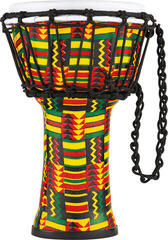
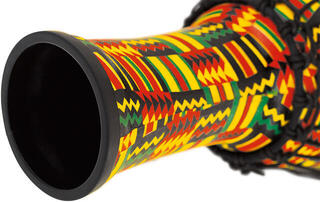
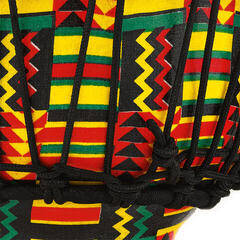
A djembe is a hand-played African drum with a goblet-shaped body that responds to palm and finger strokes. It suits you when you want a rhythm instrument for home playing, school lessons, workshops or acoustic performance without a complex setup. When choosing, focus on size, body material, head type and tuning system, because these details affect volume, response and carrying comfort. If you are starting out, a stable model at a comfortable height is more practical than the largest drum chosen only for a louder sound.
How to choose a djembe
Choose a djembe drum according to who will play it and where it will be used. A smaller instrument is easier to hold between the knees, a child can carry it to a music lesson and it does not take much space in a group. A larger djembe gives deeper bass and stronger projection, but it needs more room, a firmer hold and often a bag or stand.
Body and head material
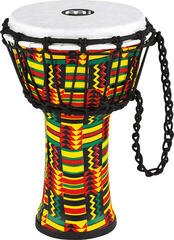
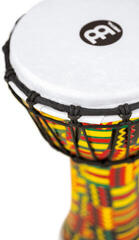
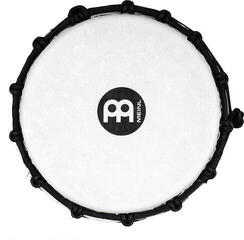
A traditional djembe has a wooden body and a natural head, often made from goatskin. This combination feels organic, each piece can differ slightly in grain and sound character, and it needs more careful handling in humidity and temperature changes. A laminate or synthetic body is practical for frequent carrying, school use and situations where durability and easy care matter. A synthetic head is usually more stable in changing conditions, while a natural head appeals to a player who wants the classic feel under the hands.
Size and sound
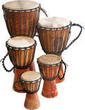
At roughly 25–40 cm high, these are mainly children's, travel or first rhythm instruments. Around 50 cm, you get a sensible compromise for a beginner, school or workshop: the drum is still portable but already offers readable bass, an open tone and a sharper slap. A djembe 60 cm and larger models suit an adult player, louder group playing or stage use where you need fuller sound and better projection.
Tuning, playing and carrying
Rope tuning is common on traditional construction and lets you tighten the head as needed, although it takes a little practice. Mechanical tuning can be easier for some players because it works more like other drums. If you will carry the djembe often, check the weight, body finish, possible strap and bag dimensions. For longer seated playing, the right instrument height also helps so you do not have to play with raised shoulders.
Djembe for beginners, school or workshop
For first playing, choose a djembe for beginners that forgives less precise technique and is not too heavy. In school or workshop use, durability, easy sound distinction and comfort during repeated use by several players are important. If you already play regularly, look for a larger djembe drum with a firmer body, a well-tensioned head and a tone that can stand out among other percussion instruments.
Options compared
| Djembe type | When it makes sense | What to watch |
|---|---|---|
| Small or children's djembe | First rhythms, children, travel, decorative playing | Less bass and shorter sustain |
| Medium djembe around 50 cm | Beginner, music school, workshop, home playing | Check comfortable height and stability between the knees |
| Large djembe 60 cm and above | Adult player, louder drum circle, performance, world music | Heavier, needs more space and better protection during transport |
Practical accessories for djembe
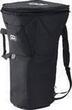
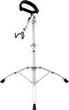
If you carry the drum to lessons, rehearsals or shows, it is worth adding bags and cases for djembe to protect the head and body from knocks. When playing seated or on stage, djembe stands can help, especially if you want a stable position and freer hand movement. Compare diameter, height and tuning method with the person who will use the instrument most often. A well-chosen djembe gives you clear rhythm, comfortable playing and a sound that will not get in the way or disappear in a group.