 Albania
 Argentina
 Australia
 Austria
 Belgium
 Bosnia and Herzegovina
 Brazil
 Bulgaria
 Canada
 Chile
Chile
 Colombia
 Croatia
 Czech Republic
 Denmark
 Estonia
 Finland
 France
 Germany
 Greece
 Hungary
 Ireland
 Italy
Italy
 Latvia
 Lithuania
 Luxembourg
 Mexico
 Moldova
 Montenegro
 Netherlands
 New Zealand
 North Macedonia
 Norway
 Philippines
 Poland
 Portugal
 Romania
 Serbia
 Slovakia
 Slovenia
 South Africa
 Spain
Spain
 Sweden
 Switzerland
 Turkey
 Ukraine
 United Kingdom
 United States of America



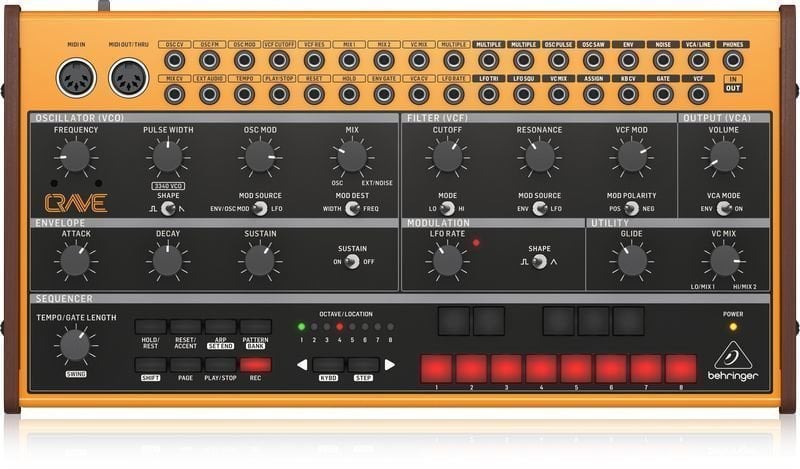
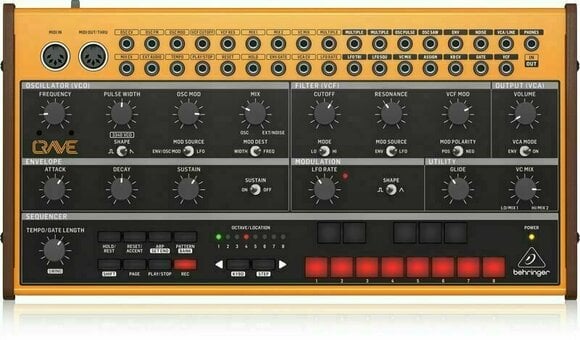
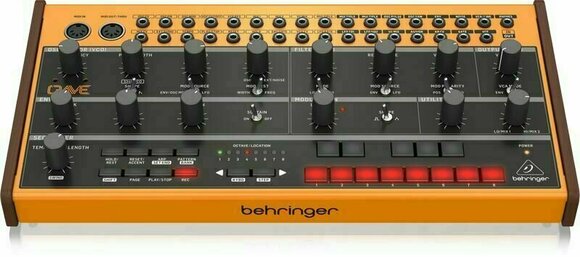
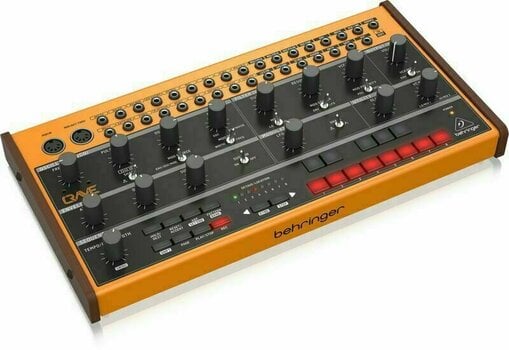
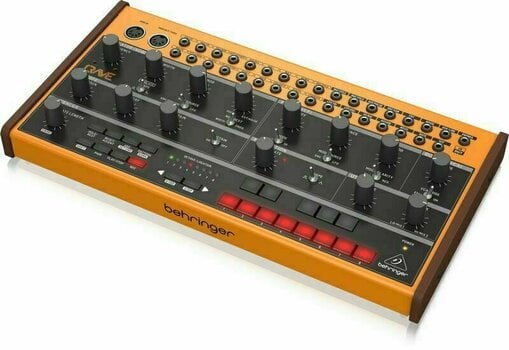


- Тype: Desktop Synthesizer, Semi-modular
- Sound Engine: Analog
- Polyphony: 1
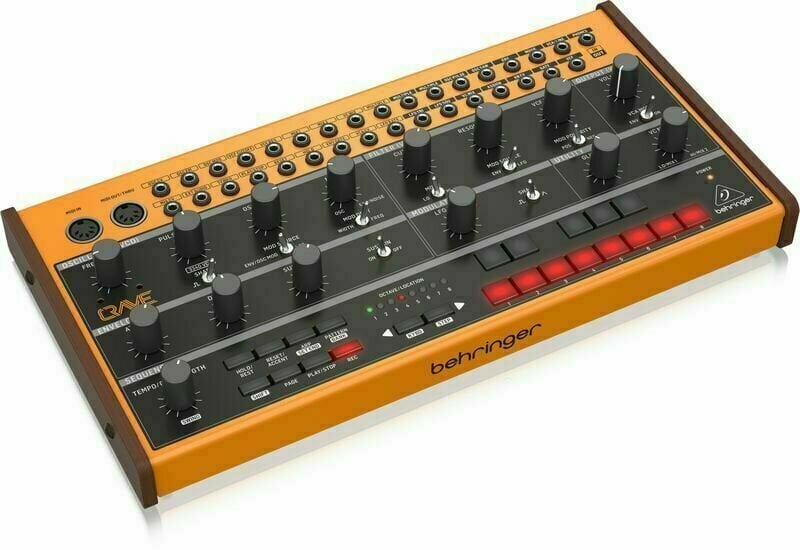
Behringer Crave Synthesizer
The Behringer Crave analog synthesizer is a compact semi-modular desktop module that delivers classic 1970s-inspired tones at an accessible price. Built around an authentic 3340 VCO and a 24 dB transistor ladder filter, it produces the warm, fat bass and lead sounds that defined progressive rock, synth-pop, and EDM.
- Shaping the sound is an authentic 3340 VCO with pulse and sawtooth waveforms, plus pulse-width modulation for vintage analog flavor.
- Expect a classic 24 dB transistor ladder filter with both low-pass and high-pass modes, as well as self-oscillating resonance for creative filter sweeps.
- Take advantage of the onboard 32-step sequencer and 8-mode arpeggiator to generate instant melodic ideas, with up to 64 patterns stored across 8 banks.
- Expand your sound with Poly Chain, linking up to 16 units for polyphony, and connect easily through full MIDI In/Out/Thru and USB-B.
Behringer Crave Analog Synthesizer — Classic Analog Voice in a Compact Desktop Module
The Behringer Crave analog synthesizer brings semi-modular analog synthesis within reach of any musician, pairing a genuine 3340 VCO with a 24 dB transistor ladder filter in a compact desktop module. Default internal routing lets players dial in fat bass, biting leads, and evolving textures straight out of the box. Dive deeper with the 18 × 14 patch matrix for advanced sonic experimentation. With 47 front-panel controls, a 32-step sequencer, and an 8-mode arpeggiator, this model rewards both performance and sound design.
What Sets the Crave Apart in the Semi-Modular Category
In the world of semi-modular synths, few offer both a true 3340 VCO and a transistor ladder filter at this level. Linking up to 16 modules using the Poly Chain function unlocks authentic polyphony, a feature seldom found outside high-end flagships. The built-in 32-step sequencer, with storage for 64 patterns and an 8-mode arpeggiator, turns this instrument into a standalone creative powerhouse.
Oscillator Architecture — The Heart of the Analog Voice
At its core is a voltage-controlled oscillator that defines the unique analog timbre. If you seek vintage tones, explore the variety of waveforms and the flexible modulation possibilities that shape every note as it sounds.
- Oscillator: Analog 3340 VCO — authentic Prophet-era chip delivers that classic "gluey" texture
- Waveforms: Sawtooth and pulse with PWM — Shape switch selects narrow, square, or wide pulse widths
- By mixing in the internal white noise source, you can add grit and percussive textures to your sound palette.
- Polyphony: 1 voice (expandable to 16 via Poly Chain)
Filter and Envelope — Shaping the Classic Analog Response
Filtering is where the Crave shines with its musical, fat tones. The transistor ladder filter reacts smoothly to adjustments, and the envelope generator gives each note a distinct shape for both attack and sustain.
- Filter: 24 dB/octave transistor ladder — switchable low-pass and high-pass modes with self-oscillating resonance
- Envelope: ADSR (Attack, Decay, Sustain + Sustain On/Off) — from sharp plucks to long pads, the envelope adapts to your playing style
- LFO: 1 analog Low Frequency Oscillator — triangle and square waveforms with LED rate indicator
- Modulation: LFO, envelope, manual, and noise routable to oscillator pitch, pulse width, and filter cutoff
Sequencer, Arpeggiator, and Patch Integration
For those who want creative control, this module comes equipped with powerful sequencing and patching options—ideal for desktop producers or as a Eurorack companion. All essential connectivity is included, alongside a comprehensive patch matrix.
- Sequencer: 32 steps, 64 patterns across 8 banks — record, save, and recall sequences in Keyboard or Step mode
- Arpeggiator: 8 modes — up, down, up-down, random, and octave-shifted patterns with latch and hold
- Patch Matrix: 18 inputs × 14 outputs — semi-modular routing for VCO, VCF, VCA, LFO, envelope, and sequencer
- The connectivity suite includes MIDI In/Out/Thru, USB-B, 3.5 mm headphone output, and external audio input—ready for DAWs, controllers, and Eurorack systems at 1V/oct.
- Dimensions: 320 × 164 × 47 mm, weight 1.5 kg
Who Will Appreciate the Crave
Those new to synthesis and experienced modular users alike will find the Crave fits both tight spaces and ambitious setups. Bedroom producers benefit from straightforward routing, while advanced users can take full advantage of the deep patch matrix. The 32-step sequencer and 8-mode arpeggiator cater to electronic musicians seeking creative basslines and intricate patterns. On stage, Poly Chain expansion, MIDI, and a compact chassis support any live rig. For educational use, it offers a tactile path into synthesis basics, patching, and analog sound creation.
Behringer and the Crave — A Modern Tribute to Classic Synthesis
Uli Behringer, the company’s founder, assembled his first synthesizer, the UB-1, at 17 while growing up in a Swiss musical family. The Crave channels that heritage by capturing the spirit of legendary 1970s synths—like the Prophet-5 and Moog’s ladder filter—within a modern module. With 47 controls on the panel and an all-analog signal path, it opens up classic synthesis for a new generation.
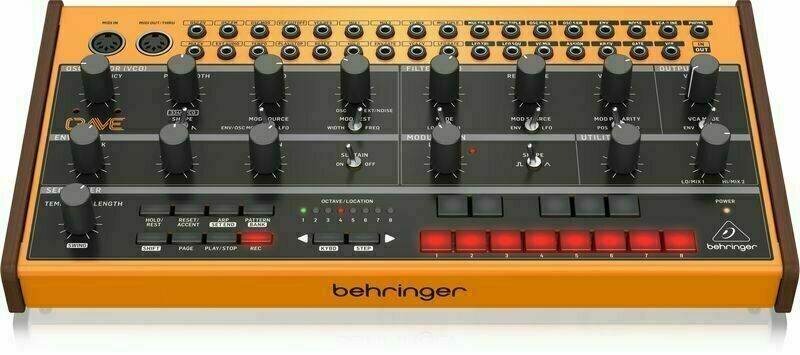
Polyphony: 1
This instrument is monophonic, meaning it plays only one note, which cannot be combined simultaneously with another.

LFO: 1
An LFO, or low frequency oscillator, brings electronic sound to life. It adds movement and interest to synthetic sounds and effects, playing an important role in both subtle synthesis and bold sound design. However, you won't hear the LFO itself because it acts as a modulator. This means that it does not directly affect the audio signal, but adjusts other parameters such as oscillator pitch and filter clipping.
Envelope: ADSR
The ADSR (Attack, Decay, Sustain, Release) type envelope filter gives you precise control over the dynamics and shape of your sound. The ADSR components are detailed as follows: Attack: Specifies how quickly the sound reaches its maximum volume upon activation. Decay: Specifies the time it takes for the volume to drop from maximum to sustain. Sustain: Represents a stable volume level that is maintained as long as the sound is active. Release: Specifies how quickly the volume fades to zero after the sound has been released.

Modulation: Yes
Modulation allows you to change different aspects of the sound in real time, opening up a wide range of creative possibilities. For example, it can affect the pitch of the sound, creating a vibrato effect, or it can change the amplitude of the signal, creating a tremolo effect. It can also adjust filtering to create smooth transitions between frequency bands and dynamic textures. Modulation can also be used to change the character of the sound depending on the time or intensity of playing, giving the sound a lively and moving character.
Sequencer: Yes
The sequencer provides musicians with a tool for composing and arranging music, allowing them to create and edit musical sequences. This feature allows you to record and play back repeating patterns. This makes it easy to create complex rhythms and melodies. The sequencer also allows you to layer different musical elements on top of each other, sync with other devices, and adjust parameters in real time. This flexibility makes the sequencer an invaluable tool for producing music, experimenting with new sounds and creating original compositions.
Arpeggiator: Yes
The Arpeggiator transforms chords into sequences of individual notes played in various rhythmic and melodic patterns. Instead of playing the chords as a harmonic whole, the Arpeggiator breaks the chords into individual notes and plays them sequentially according to the selected algorithm.
Headphone Output: Yes
The headphone output allows direct connection of headphones for private listening. This output provides a convenient way to enjoy the sound without disturbing others or ambient noise.
Inputs
- Jack 3,5 mm TRS
- CV (patchpoints)
Outputs
- Jack 3,5 mm
- CV (patchpoints)
MIDI Interface: Yes
It supports MIDI, allowing you to connect and communicate with other MIDI-compatible devices. This feature extends control and integration into the larger music environment, increasing flexibility and creativity in music creation.
Package Contents
- Adapter
- Manual

Тype
Desktop Synthesizer, Semi-modular
Aftertouch
LFO
Envelope
ADSR
Oscillators
Modulation
Arpeggiator
Effect Types
MIDI Interface
Bluetooth
Headphone Output
Outputs
Pedal Inputs
USB
USB MIDI
Filter
Low Pass, High Pass
Sequencer
Yes
Power Supply
Adapter
UK/EU Power supply included
Width (cm)
32
Height (cm)
4.7
Depth (cm)
16.4
Net Weight (kg)
1.5
Made in
China


All reviews come from verified customers who have purchased a product from us in the past.
AI summary of reviews
Based on the number of reviews: 29
Strengths
- Sound quality: Customers consistently highlight the excellent and powerful sound produced by this synthesizer, capable of deep basses, leads, and pads.
- Value for money: Many users consider this product an outstanding value, offering professional-grade features and sound at an incredibly affordable price point.
- Versatility and modularity: The synthesizer is highly versatile, functioning as a simple synth with advanced MIDI and modular capabilities, making it suitable for complex sound design and integration with other studio equipment.
- Build quality: The device features a metal chassis and sturdy knobs, giving it a good and durable feel according to customer feedback.
- Sequencer and arpeggiator: The built-in sequencer and arpeggiator are highly effective and detailed, allowing for extensive sound manipulation and creative possibilities.
Weaknesses
- Manual and learning curve: The included manual is often described as poorly written or succinct, requiring users to rely on forums, YouTube tutorials, or self-exploration to learn its in-depth features.
- Fiddly sequencer and functions: Some users find the sequencer fiddly and note that many buttons have multiple functions, making it challenging to learn and master the machine's operations.
- Main output jack: The main output uses a mono 3.5mm jack, which is an uncommon cable type for many users.
What customers repeat
Verdict
Documents
Instructions for use
Manufacturer information
Safety instructions
Please refer to the user manual for the specific safety instructions for this product.


