 Albania
 Argentina
 Australia
 Austria
 Belgium
 Bosnia and Herzegovina
 Brazil
 Bulgaria
 Canada
 Chile
Chile
 Colombia
 Croatia
 Czech Republic
 Denmark
 Estonia
 Finland
 France
 Germany
 Greece
 Hungary
 Ireland
 Italy
Italy
 Latvia
 Lithuania
 Luxembourg
 Mexico
 Moldova
 Montenegro
 Netherlands
 New Zealand
 North Macedonia
 Norway
 Philippines
 Poland
 Portugal
 Romania
 Serbia
 Slovakia
 Slovenia
 South Africa
 Spain
Spain
 Sweden
 Switzerland
 Turkey
 Ukraine
 United Kingdom
 United States of America



How to choose a djembe
The djembe is a West African hand drum you can play a first rhythm on straight out of the box. We go through the four decisions that drive both price and sound: size, head, shell material and tuning system.
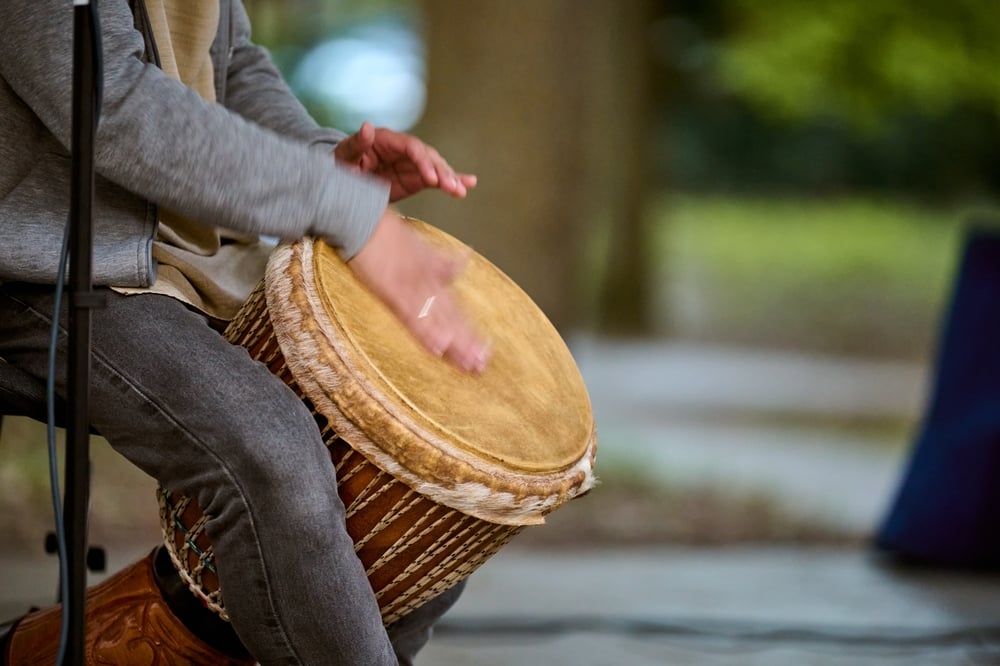
A djembe is one of the few instruments you can play something meaningful on within five minutes of unboxing, and one you can still be improving on years later. It needs no amp, no cable and no power socket, just a chair and two hands, and it will comfortably out-shout an acoustic guitar. That is exactly why you see it at summer camps, in drum circles, at folk band rehearsals and in the living rooms of people coming back to music after a fifteen-year break.
The trouble starts the moment you open the djembe listings and find that two drums of the same size can differ in price fivefold. That is not marketing, it is four specific things you have to decide on: what size, which head, what the shell is made of and how it tunes. We will go through them in exactly that order, because that is the order anyone standing in a shop works through them. At the end we add specific models, the accessories that genuinely pay off, and a few tips to keep the drum going for years.
The trouble starts the moment you open the djembe listings and find that two drums of the same size can differ in price fivefold. That is not marketing, it is four specific things you have to decide on: what size, which head, what the shell is made of and how it tunes. We will go through them in exactly that order, because that is the order anyone standing in a shop works through them. At the end we add specific models, the accessories that genuinely pay off, and a few tips to keep the drum going for years.
Why such a small drum is so loud
The djembe comes from West Africa, from the region of present-day Mali, Guinea and Senegal, where it was carved for centuries from a single piece of hardwood with a goat skin stretched over it. The whole secret is in the shape. The shell is a wide bowl at the top, narrows into a stem in the middle and flares out again towards the ground, so the air inside speeds up and shoots out of the bottom opening. It works much like a megaphone, except a palm strike sets it going instead of a voice.
That also determines how you sit at a djembe. You hold the drum between your knees, tilted slightly forward so nothing blocks the bottom opening, and that is all there is to it. Sit it flat on the floor and it loses about half its volume, which is the single most common mistake among people who bought one without ever seeing anyone play. If you would rather not sit, there are djembe stands that lift it for you.
That also determines how you sit at a djembe. You hold the drum between your knees, tilted slightly forward so nothing blocks the bottom opening, and that is all there is to it. Sit it flat on the floor and it loses about half its volume, which is the single most common mistake among people who bought one without ever seeing anyone play. If you would rather not sit, there are djembe stands that lift it for you.
The three strokes you learn first
Before you start comparing models, it pays to know what you will actually be doing on them, because that is what decides what you need from the drum. Playing a djembe rests on three strokes. The bass is played with the full palm into the centre of the head and sounds deep and soft. The tone comes from fingers held together right at the edge, pulling the hand away immediately after contact, and it is that clear, singing note. The slap is the sharp crack at the edge, played with relaxed fingers, and for most people it takes the longest to come out cleanly.
And the slap is exactly where you hear the difference between a cheap drum and a good one, because a thin head or slack ropes simply will not give you that stroke, no matter how hard you try. So if you are picking your first djembe and want it to last beyond one summer, skip the very bottom shelf. That is the whole reason it is worth working through those four decisions properly.
And the slap is exactly where you hear the difference between a cheap drum and a good one, because a thin head or slack ropes simply will not give you that stroke, no matter how hard you try. So if you are picking your first djembe and want it to last beyond one summer, skip the very bottom shelf. That is the whole reason it is worth working through those four decisions properly.
Decision one: size
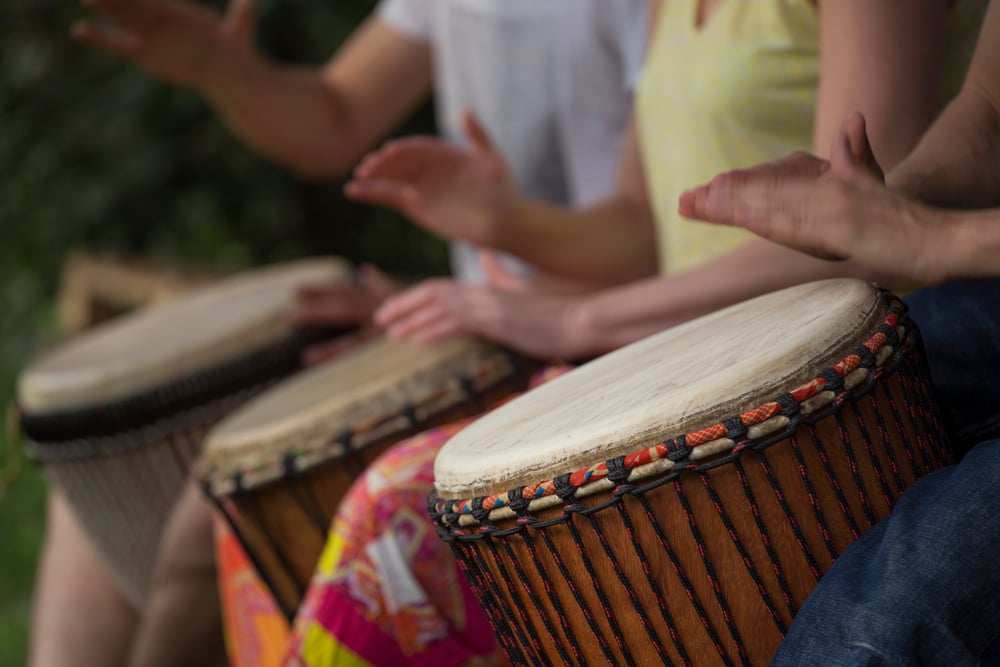
The size of a djembe is given as the head diameter in inches and the height in centimetres, and the two figures go together, so you only really need to remember one. An adult of average build sits most comfortably at a drum with a twelve-inch head and a height of around sixty centimetres, and that is also the size with the widest choice of models.
If you are over one metre eighty, go for thirteen or fourteen inches and a height of sixty-five centimetres instead, otherwise you will hunch over it and your back will complain after half an hour. Ten-inch drums suit teenagers, playing standing up with a strap, and anyone who carries the instrument around, whether to school or to rehearsal.
Eight inches and under belongs to children, and there it is worth looking at kids percussion too, where you will find full sets and smaller hand drums. With children it matters more that the drum is not too tall and that they can reach the floor with their feet than that it is loud.
If you are over one metre eighty, go for thirteen or fourteen inches and a height of sixty-five centimetres instead, otherwise you will hunch over it and your back will complain after half an hour. Ten-inch drums suit teenagers, playing standing up with a strap, and anyone who carries the instrument around, whether to school or to rehearsal.
Eight inches and under belongs to children, and there it is worth looking at kids percussion too, where you will find full sets and smaller hand drums. With children it matters more that the drum is not too tall and that they can reach the floor with their feet than that it is loud.
Decision two: goat skin or synthetic
Goat skin is what gives a djembe its characteristic sound. It varies in thickness, every single hide sounds a little different, the slap is louder with it and the whole drum feels more alive under your hands. The price you pay is that it responds to the weather, so it goes slack in damp air and tightens up in a dry heated flat, and you will have to retune it now and then.
A synthetic head is the exact opposite. It sounds the same in January as in August, you never have to think about it, and it survives playing outdoors in the rain. The slap is harder and less colourful with it, but that difference is mostly heard by you under your own palms, not by someone standing ten metres away.
Simplified, it comes down to this: for home and for drum circles take skin, for camps, for school and for anywhere you will be carting it about take synthetic. And if a head ever gives out, that is not the end of the instrument, replacements are in percussion heads.
A synthetic head is the exact opposite. It sounds the same in January as in August, you never have to think about it, and it survives playing outdoors in the rain. The slap is harder and less colourful with it, but that difference is mostly heard by you under your own palms, not by someone standing ten metres away.
Simplified, it comes down to this: for home and for drum circles take skin, for camps, for school and for anywhere you will be carting it about take synthetic. And if a head ever gives out, that is not the end of the instrument, replacements are in percussion heads.
Decision three: what the shell is made of
A traditional African djembe is carved from a single piece of hardwood, usually lenke or djalla, and you recognise it because the inside is not smooth and still shows the marks of the chisel. It sounds the fullest and has the most low end, but it is also the heaviest, the most expensive and the most sensitive to humidity, so it is a choice for someone who already knows what they want.
Far more common are mahogany drums made in Indonesia and Thailand, which follow the African original in both shape and sound but are cheaper and more stable dimensionally. For most people that is the sensible middle road, because the difference in sound is smaller than the difference in price.
The third group is fibreglass shells. They do not crack, rain and frost do not bother them, and they sound louder and brighter than wood. If you plan to play outdoors, at festivals or with children, that is the most practical answer, even at the cost of warmth in the tone.
Far more common are mahogany drums made in Indonesia and Thailand, which follow the African original in both shape and sound but are cheaper and more stable dimensionally. For most people that is the sensible middle road, because the difference in sound is smaller than the difference in price.
The third group is fibreglass shells. They do not crack, rain and frost do not bother them, and they sound louder and brighter than wood. If you plan to play outdoors, at festivals or with children, that is the most practical answer, even at the cost of warmth in the tone.
Decision four: rope or hardware
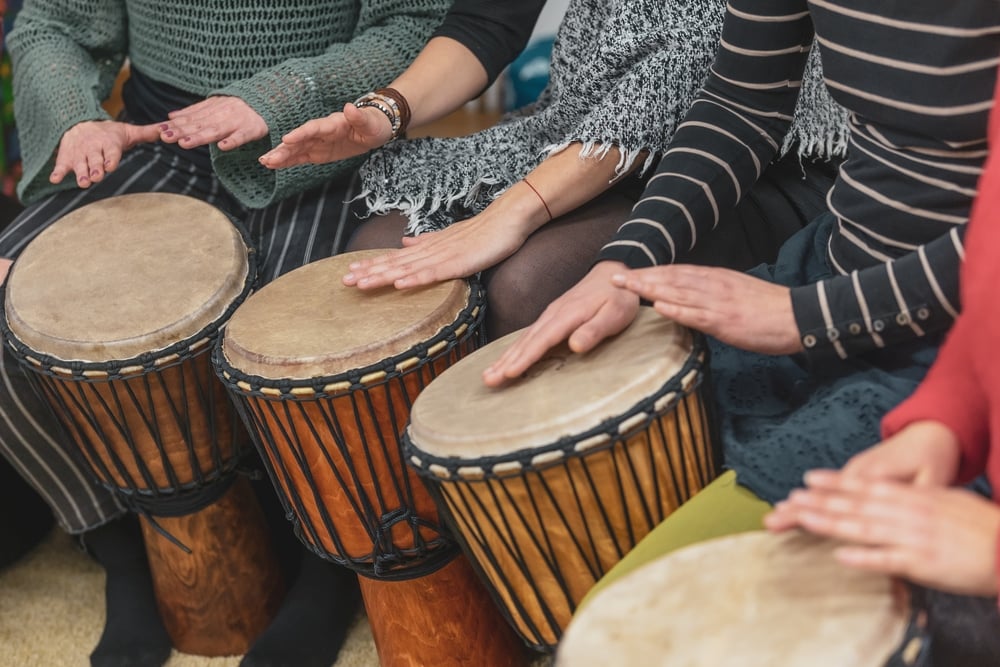
A classic djembe is rope tuned, with cord running between the top and bottom rings, and you raise the tension by weaving it into a diamond pattern. It sounds more complicated than it is. You will learn it in one afternoon from a video, and once you have it, you can retune the drum anywhere without a single tool.
A mechanically tuned djembe has bolts and lugs instead of rope, much like a drum kit, so tuning takes a minute with a drum key. It is the answer for teachers, for band players who need to adjust quickly, and for anyone put off by rope weaving before they even start.
There is no fundamental difference in sound between them, so decide by temperament rather than by ear. Rope drums tend to be lighter and look more traditional, mechanical ones are more practical and a touch heavier.
A mechanically tuned djembe has bolts and lugs instead of rope, much like a drum kit, so tuning takes a minute with a drum key. It is the answer for teachers, for band players who need to adjust quickly, and for anyone put off by rope weaving before they even start.
There is no fundamental difference in sound between them, so decide by temperament rather than by ear. Rope drums tend to be lighter and look more traditional, mechanical ones are more practical and a touch heavier.
So which model should you buy
Once those four things are settled, the choice narrows to a handful of names. Meinl has the widest range and covers every level. As a first djembe for an adult, the Meinl HDJ4 Headliner makes sense, with a mahogany shell and a goat head, available from eight to thirteen inches, so you can hit the size from decision one exactly. If you want a more traditional sound, the Journey series has it, where the Meinl FADJ7 brings a thicker shell and a stronger low end.
If decision two landed you on synthetic, the Meinl Alpine Series is built exactly for that and shrugs off rain and cold. And if the ropes put you off, the Meinl PMDJ1 Mechanical Tuned Travel has bolt tensioning and comes with either a goat or a synthetic head, so you can still follow decision two. At the top of the range sits the Meinl Professional African Style, a drum made in Africa from hardwood and rope tuned, with a completely different dynamic range from anything below it.
Toca Percussion builds its Freestyle line on a fibreglass shell that is practically indestructible and comes in both a rope tuned and a mechanically tuned version, which makes it the natural pick for schools, camps and outdoor playing. Terre offers mahogany djembes across the whole range of heights from thirty to sixty-five centimetres, and in the Professional Player line, serious instruments for experienced players. For children the safest choice is Nino, which makes smaller sizes and pre-tuned fibreglass models that need no maintenance at all.
If decision two landed you on synthetic, the Meinl Alpine Series is built exactly for that and shrugs off rain and cold. And if the ropes put you off, the Meinl PMDJ1 Mechanical Tuned Travel has bolt tensioning and comes with either a goat or a synthetic head, so you can still follow decision two. At the top of the range sits the Meinl Professional African Style, a drum made in Africa from hardwood and rope tuned, with a completely different dynamic range from anything below it.
Toca Percussion builds its Freestyle line on a fibreglass shell that is practically indestructible and comes in both a rope tuned and a mechanically tuned version, which makes it the natural pick for schools, camps and outdoor playing. Terre offers mahogany djembes across the whole range of heights from thirty to sixty-five centimetres, and in the Professional Player line, serious instruments for experienced players. For children the safest choice is Nino, which makes smaller sizes and pre-tuned fibreglass models that need no maintenance at all.

What to add to it
A djembe on its own is enough to play, but three things pay off for almost everyone. The first is a bag, because the shell is bare wood on the outside and one trip in a car boot can scuff it. In djembe bags and cases you will also find soft versions with backpack straps, so you can carry the drum on a bike.
The second is a stand, which lifts the drum and leaves the bottom opening clear. You will appreciate it mainly on longer sessions when you do not want to grip it with your knees the whole time, and at gigs where you need your hands free.
The third is a strap, if you plan to play standing up. And once the playing takes hold and you want to widen the sound, the most common additions to a djembe are congas and bongos, or a cajon, which covers bass and snare at once and which we cover in a separate article on how to choose a cajon.
The second is a stand, which lifts the drum and leaves the bottom opening clear. You will appreciate it mainly on longer sessions when you do not want to grip it with your knees the whole time, and at gigs where you need your hands free.
The third is a strap, if you plan to play standing up. And once the playing takes hold and you want to widen the sound, the most common additions to a djembe are congas and bongos, or a cajon, which covers bass and snare at once and which we cover in a separate article on how to choose a cajon.
Making it last for years
A djembe needs almost nothing, but three things do it real harm. The first is direct sun and radiators, which dry the skin out until it cracks. The second is a damp cellar or garage, where the head goes slack and the wood swells. The third is sticks, which the instrument is not built for and which will punch through the skin faster than you expect, so save them for congas, timbales and blocks.
Routine care takes about a minute. Wipe the head with a dry cloth after playing and occasionally give the ropes a gentle pull when you hear the pitch has dropped. If the head does tear, replacing it is a completely ordinary repair, new ones are in percussion heads and the principle is the same as on a drum kit, where our article on how to change drumheads takes you through it step by step.
Routine care takes about a minute. Wipe the head with a dry cloth after playing and occasionally give the ropes a gentle pull when you hear the pitch has dropped. If the head does tear, replacing it is a completely ordinary repair, new ones are in percussion heads and the principle is the same as on a drum kit, where our article on how to change drumheads takes you through it step by step.
The short version
Pick the size by your own height, and for an adult twelve inches is a safe bet. Pick the head by where you will play, skin for indoors and synthetic for outdoors. The shell decides how warm the tone is, with mahogany the sensible middle ground between price and sound and fibreglass the one that survives anything. And pick the tuning by temperament, rope if you enjoy the craft and hardware if you want it done in a minute.
Work through those four and the choice stops being a lottery. The full range is in the djembe category, and if you are still torn between types of hand drum, have a look at congas, bongos and cajons too. If you are after something calmer in the hands, look at kalimbas or at instruments for music therapy.
Work through those four and the choice stops being a lottery. The full range is in the djembe category, and if you are still torn between types of hand drum, have a look at congas, bongos and cajons too. If you are after something calmer in the hands, look at kalimbas or at instruments for music therapy.
Frequently asked questions
Can I manage a djembe if I have never played anything?
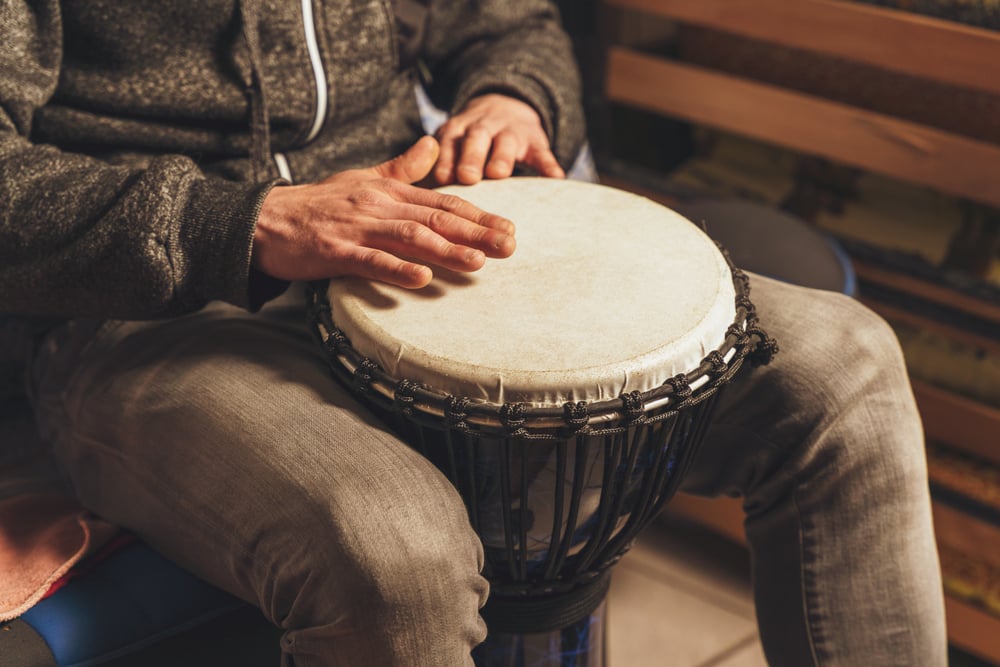
You can, and faster than you expect. You need no sheet music, no tuner and no teacher, and you will play your first usable rhythm the same day you unbox the drum. At the same time a djembe has enough depth to keep you interested years later, once you get to slaps and to playing in a group.
What size djembe should I buy for a child?
For children under ten, a six to eight inch head and a height of up to forty centimetres works, and for older children eight to ten inches. More important than the diameter, though, is how they sit: the child has to reach the floor with their feet and hold the drum between their knees. Smaller sizes are also in kids percussion.
How often will I have to tune the djembe?
With a goat head, check it every few weeks and always after a big change of environment, for instance when you bring it in from the car into a heated room. With a synthetic head you practically never tune it, and that is its main advantage.
Will the neighbours complain?
Let us be straight about it: a djembe is louder than you imagine, especially the bass and the slap. A smaller size helps, so does playing at a softer dynamic and putting a mat under the drum to damp the transfer into the floor. In a block of flats it pays to agree times with the neighbours, exactly as you would with a drum kit.
Goat skin or synthetic for a beginner?
If you will play mostly at home, take skin, it sounds more alive and you learn to feel how the instrument responds to the weather and to your hands. If you will be carting the drum off to camps and playing outdoors, synthetic saves you a lot of bother and sounds the same every time.