Albania
 Argentina
 Australia
 Austria
 Belgium
 Bosnia and Herzegovina
 Brazil
 Bulgaria
 Canada
 Chile
 Colombia
 Croatia
 Czech Republic
 Denmark
 Estonia
 Finland
 France
 Germany
 Greece
 Hungary
 Ireland
 Italy
 Latvia
 Lithuania
 Luxembourg
 Mexico
 Moldova
 Montenegro
 Netherlands
 New Zealand
 North Macedonia
 Norway
 Philippines
 Poland
 Portugal
 Romania
 Serbia
 Slovakia
 Slovenia
 South Africa
 Spain
 Sweden
 Switzerland
 Turkey
 Ukraine
 United Kingdom
 United States of America



Delays
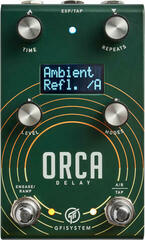
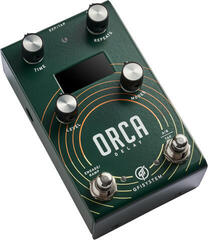
Delay repeats a played note or chord as an echo, adding space, depth and rhythmic movement to your playing. A guitar delay pedal is connected before the amplifier or in the effects loop, and its sound is determined by the delay time, number of repeats and balance between the echo and original signal. When choosing one, consider the type of delay, time range, tap tempo, number of memory slots and the pedal's size on your pedalboard. The range includes delay pedals from brands such as Boss, TC Electronic, Joyo and Nux.
Which type of delay do you need?
| Type | Sound character | Best suited for |
|---|---|---|
| Analogue delay | Darker, warmer echoes that soften with every repeat | Blues, rock and playing with a more natural sound |
| Digital delay | Clean and precise repeats, often with a longer delay time | Rhythmic playing, ambient soundscapes and precise tempo synchronisation |
| Tape echo | A sound inspired by tape echoes, with subtle fluctuations | Retro tones and a vintage atmosphere |
How delay shapes your sound
The basic controls are time (the interval between echoes), feedback (the number of repeats) and mix (the balance between the echo and original signal). Tap tempo allows you to set the time by tapping your foot in time with the song. For melodic parts, it is worth setting the delay to softer echoes, while precise repeats work well for rhythmic parts. A high number of repeats and a long delay time can make the sound cluttered, so adjust it according to the density of your playing and the size of the venue. Testing the setting with a metronome can also help.
What to check before buying
- Maximum delay time and memory for saving settings.
- Stereo or mono configuration if you use multiple amplifiers.
- Bypass type and foot control, especially on stage.
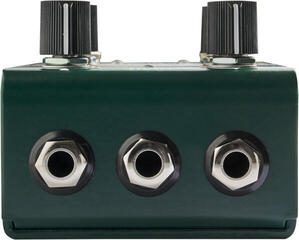
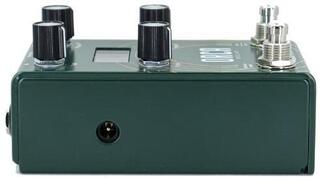
- Dimensions and power requirements, so the pedal fits your pedalboard.
- Sonic versatility: multiple modes and echo modulation.
Delay in your complete effects setup
Delay is often combined with reverb, which softens the ambience, or with a looper for layering phrases. For a more aggressive guitar signal, place it after an overdrive or distortion. If you need more functions in one unit, see guitar multi-effects and processors.
You can find more pedals in the guitar effects category. Before buying, consider where you will place it in your effects chain so that your sound remains clear.