Albania
 Argentina
 Australia
 Austria
 Belgium
 Bosnia and Herzegovina
 Brazil
 Bulgaria
 Canada
 Chile
 Colombia
 Croatia
 Czech Republic
 Denmark
 Estonia
 Finland
 France
 Germany
 Greece
 Hungary
 Ireland
 Italy
 Latvia
 Lithuania
 Luxembourg
 Mexico
 Moldova
 Montenegro
 Netherlands
 New Zealand
 North Macedonia
 Norway
 Philippines
 Poland
 Portugal
 Romania
 Serbia
 Slovakia
 Slovenia
 South Africa
 Spain
 Sweden
 Switzerland
 Turkey
 Ukraine
 United Kingdom
 United States of America



100V Ampifiers
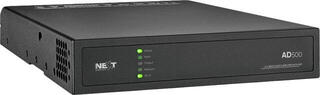
100 V amplifiers are designed for distributed sound systems with multiple compatible speakers and longer cable runs. They are used in schools, shops, public buildings, commercial premises and suitably designed outdoor installations where sound needs to cover multiple zones. Instead of calculating a low-impedance load, you work with the power transformer taps on the speakers and monitor the sum of their selected wattages. The design and wiring must comply with the equipment documentation, electrical safety requirements and the necessary power headroom.
How a 100 V system works
The amplifier carries audio over a higher-voltage line, and each installation speaker uses a transformer with selectable power taps. During design, you therefore add together the selected ratings of all speakers connected to a given output or zone. The resulting total must remain below the amplifier's usable output, with the headroom recommended by the manufacturer and project specification. A 100 V designation does not mean that you can connect any speaker.
Compared with a conventional low-impedance system, this type of distribution makes it easier to connect a larger number of locations, especially when the speakers are far apart. The quality of the result, however, depends on the design, cable cross-section, tap settings, speaker placement and signal processing. An incorrectly calculated load or a combination of incompatible outputs may activate protection or damage the equipment.
Power budgeting without guesswork
- List all speakers in each zone and the tap setting that will be used on each one.
- Add up the speaker wattages separately for each amplifier channel.
- Add appropriate headroom according to the manufacturer's instructions and project requirements.
- Check the cable length and cross-section, the cable installation method and local safety regulations.
- Before connecting, verify that all branches and speakers are designed for the same type of distribution system.
A higher tap setting on a speaker generally means a greater share of the available power, not automatically a better setting. A lower level may be sufficient in a corridor than in a busy open zone. Clearly arranged branches are easier to check and modify later. If you are uncertain about the calculation, the design should be left to a qualified professional. This applies without exception to any system with a safety function.
Which amplifier suits a particular installation?
| Requirement | Feature to look for | Question to check |
|---|---|---|
| One shared zone | One appropriately rated 100 V output and simple controls | Is the sum of the tap settings, including headroom, within the permitted range? |
| Multiple independent areas | Separate zone outputs or channels and independent levels | Can each zone play the required source and announcement? |
| Music and speech | Microphone and line inputs, priority or music ducking | How does the system behave when the priority input is activated? |
| Continuous operation | Adequate cooling, protection circuits and service-accessible wiring | Does the equipment have the clearance around it specified by the manufacturer? |
| Future expansion | Spare channel capacity and documented branches | Is the planned headroom realistic, or merely unused excess capacity? |
Inputs, zones and priorities
Signal sources and the priority input
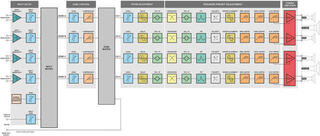
An integrated installation amplifier may combine the power-amplifier section with a small mixer, media player or zone routing. Before buying, draw out your sources: a music player, a microphone for announcements and possibly a signal from a master system. You will then know how many inputs you actually need and which ones require priority. An emergency announcement function cannot be assumed merely because the device has a microphone input.
What zone control means
Zone control may mean only switching a branch on and off, separate volume control or a completely independent programme. These capabilities differ between models. Also check whether local volume controllers are compatible with the selected 100 V system and what load they add. Keep a clear schematic near the distribution cabinet so that service personnel do not have to guess where each branch leads.
Speakers and the environment
Ceiling speakers are often chosen for indoor use because they can create a greater number of smaller listening points. However, do not determine the number of speakers from the floor area alone. Consider the ceiling height, room layout, ambient noise and required speech intelligibility. Distributing more speakers at a lower level is often more effective than using one loud source, but the design is always decisive.
For outdoor areas, choose outdoor speakers with properties suited to the particular location. Amplifier durability and speaker durability are two different matters; the power unit is often installed in a protected technical space. Temperature, humidity, direct sunlight and the mounting method must all remain within the limits specified in the documentation for each component.
100 V or a low-impedance system?
- 100 V system: makes sense with many speakers, branches and longer cable runs when distributed audio and simpler power budgeting are priorities.
- Low-impedance system: is usually the more natural choice for conventional stage speakers, shorter cable runs and a system designed around a specific impedance.
- Combination: is possible only through outputs and interfaces intended by the manufacturer; do not connect a 100 V output directly to a conventional low-impedance speaker.
If you are planning a conventional stage sound system rather than a fixed installation, you will find a more suitable overview among power amplifiers. Neither technology is better for every situation. They differ in load, cabling and typical mode of operation.
Installation, commissioning and servicing
Install the amplifier in a dry, ventilated and accessible location in accordance with the manual. Label cables at both ends, draw the zones on a plan and record the selected speaker tap settings. Before initial commissioning, measure and check the wiring using a procedure appropriate for the system; do not perform tests that could damage connected electronics. Increase the level gradually and check each zone separately.
When adding a speaker later, finding a spare terminal is not enough. Update the power total, check the cable and confirm whether the purpose of the zone changes. Regular checks of ventilation, terminals and announcement intelligibility can help identify a fault before a branch falls completely silent. Work on fixed electrical installations and systems subject to regulations must be carried out by a suitably qualified person.
To compare models, prepare a floor plan, the number of zones, a list of speakers with their tap settings, and the signal sources. Add the installation conditions and control requirements. The power rating on the front panel comes later in the process. This allows you to use a 100 V system for its intended purpose: distributing sound to multiple locations without mixing incompatible connections.