Why bother with quiet playing?
Anyone living in a block of flats knows the feeling. You want to play in the evening after work or practise every day, but the thin walls give away every note and suddenly the mood on the landing is tense. The good news is that the answer is not to play less or to hunch over a muffled sound. It is enough to reach for an instrument you can play through headphones or quieten significantly. Then you play at full volume even at midnight, focus better, and the people around you have no idea you are playing at all. That is exactly why quiet instruments are one of the most common choices for people who live in a flat and do not want to compromise on how much and when they play.
Which instruments are quietest for a flat?
The quietest are electronic and digital instruments with a headphone output, because the sound goes straight to the headphones and almost nothing escapes into the room. The king of the flat is the
digital piano, closely followed by
electronic drums, an
electric guitar with a headphone amp and silent
electric violins. Acoustic instruments can be quietened with a mute, but you will never make them truly silent. Below is a quick overview and then we go through each instrument in more detail.
Instrument | How to quieten it | Noise for the neighbours |
|---|
Digital piano | headphones | very low |
Electronic drums | mesh heads + headphones | low |
Electric guitar | headphone amp | very low |
Silent / electric violin | headphone output | very low |
Acoustic piano, drums, brass | mute | medium |
Digital piano
If you play the keys, a
digital piano is a clear number one for a flat. It has weighted keys that behave much like an acoustic piano, so you do not ruin your technique, and at the same time you plug in headphones and not a single note reaches the room. As a bonus it never needs tuning and takes up far less space than a grand or an upright. If you are picking your first model and are not sure what to look for, go through the guide
how to choose a digital piano, where we cover the key count and the type of keyboard.

Electronic drums
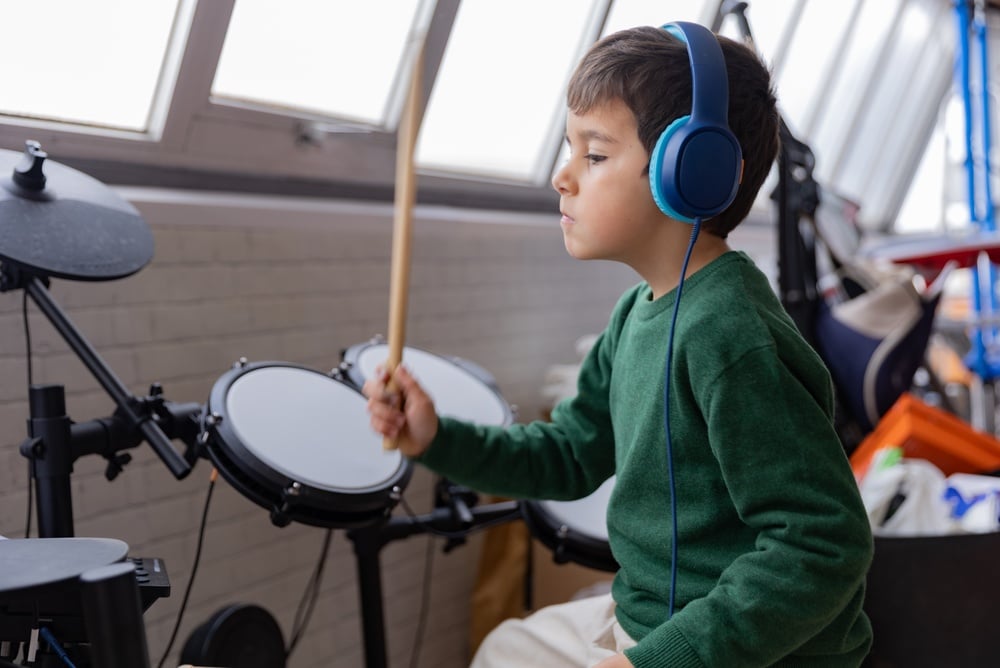
Acoustic drums are practically impossible in a flat because they boom through the whole building. The answer is
electronic drums with mesh heads, which are far quieter to play and through headphones only you hear the full sound. Only a gentle tapping of the sticks on the pads makes it into the room, which is a world away from the din of an acoustic kit. If you are hesitating between electronic and acoustic, the comparison
electronic vs acoustic drums will help.
Electric guitar with headphones
An
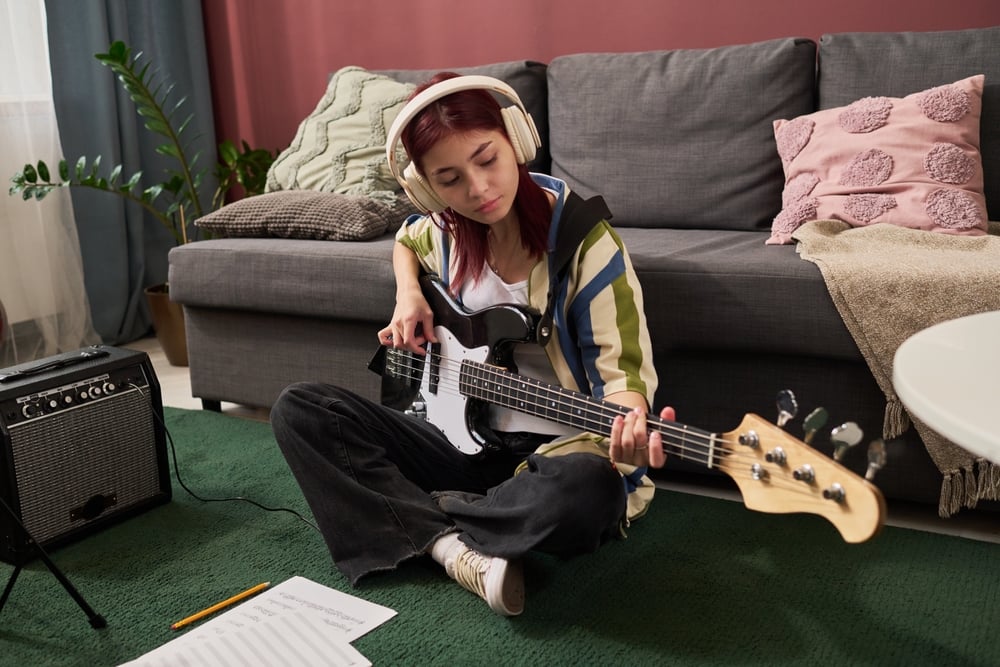
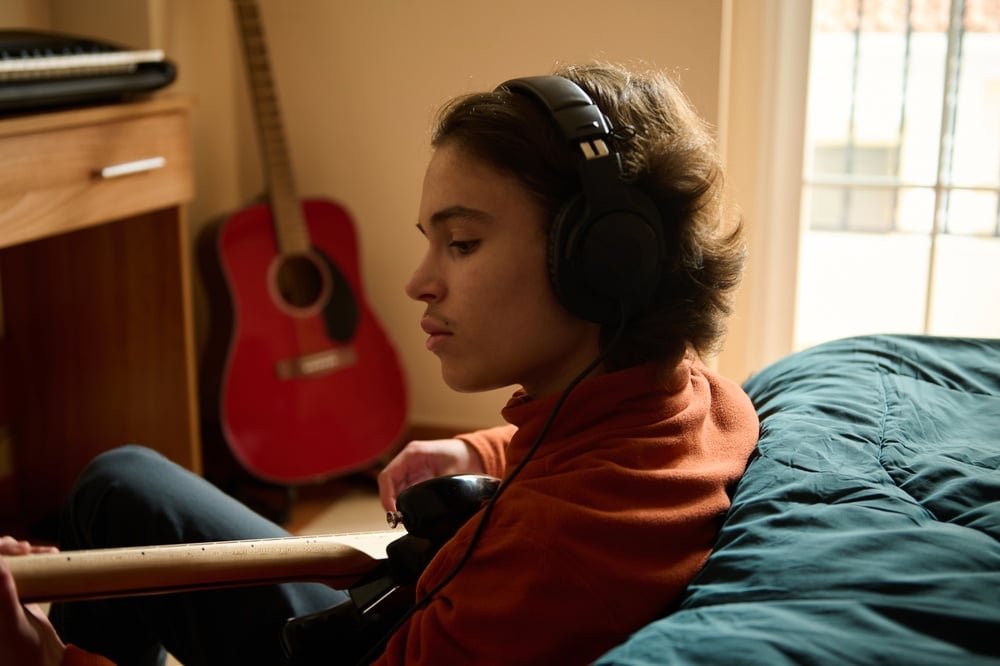
electric guitar is quiet on its own, because an unamplified string sounds only very softly. When you add a small
headphone amp or a plug-in adapter straight into the headphones, you get the full sound including effects, yet almost nothing comes out. It is the ideal combination for anyone who wants to turn up in the evenings and enjoy some distortion without the neighbour banging on the wall.
Silent violin and a mute
String players have a solution too. There are silent, that is
electric violins with a headphone output, on which you practise in complete quiet. If you do not want to change instruments, you can fit a heavy metal mute on a regular acoustic violin, which greatly reduces the volume. It will not be total silence like on the electric ones, but for evening practice in a flat it is plenty.

What if you already have an acoustic instrument?
You do not have to buy a new instrument straight away, a lot of things can be quietened with cheap accessories. For drums there are damping pads and rubber pads that you place on the heads and cymbals, and the noise drops to a fraction. For the trumpet and other brass you fit a handy practice mute, and for the violin and cello a metal mute. None of these will turn the instrument fully silent, but they pull the volume down to a level a flat and the neighbours handle much better.
Tips for playing quietly and staying out of trouble
It is not only about the instrument itself; how and when you play makes a big difference too. A few small things can turn a problematic neighbour into a tolerant one.
Tip | Why it helps |
|---|
Play through closed-back headphones | the sound never leaves the room |
Put the instrument on a rug or anti-vibration pad | dampens vibration and rumble into the floor |
Move the instrument away from the shared wall | less sound reaches the neighbour |
Practise during the day, not after 10 pm | quiet hours apply in the evening |
Agree with the neighbours in advance | when they know, they are more tolerant |
MUZIKER TIP:
The cheapest way to have peace at home is a good pair of closed-back headphones. Through them you hear a clean sound, focus better and almost nothing escapes. They are the basic you want with every quiet instrument, and a great place to start.
Frequently asked questions about quiet playing at home
Can you play a digital piano completely silently?
Yes. With headphones plugged in, practically nothing reaches the room and only the player hears it. That is exactly why a
digital piano is the most popular choice for a flat where you do not want to disturb anyone.
Are electronic drums really quiet?
They are much quieter than acoustic ones. With mesh heads and headphones only a gentle tapping of the sticks gets out. It is not total silence, but a flat handles it.
How do you quieten an acoustic guitar or violin?
An acoustic guitar plays more quietly than drums or brass, but you cannot fully silence it. On a violin you fit a metal mute that softens the sound. If you want real quiet, reach for an electric version with headphones, for example
electric violins.
Until what time can I play at home?
Follow the quiet hours, which usually run from 10 pm to 6 am. With a headphone instrument you play calmly outside that window too, because nothing sounds out into the surroundings.
Pick an instrument you can play even at midnight
 Albania
 Argentina
 Australia
 Austria
 Belgium
 Bosnia and Herzegovina
 Brazil
 Bulgaria
 Canada
 Chile
Chile
 Colombia
 Croatia
 Czech Republic
 Denmark
 Estonia
 Finland
 France
 Germany
 Greece
 Hungary
 Ireland
 Italy
Italy
 Latvia
 Lithuania
 Luxembourg
 Mexico
 Moldova
 Montenegro
 Netherlands
 New Zealand
 North Macedonia
 Norway
 Philippines
 Poland
 Portugal
 Romania
 Serbia
 Slovakia
 Slovenia
 South Africa
 Spain
Spain
 Sweden
 Switzerland
 Turkey
 Ukraine
 United Kingdom
 United States of America