 Albania
 Argentina
 Australia
 Austria
 Belgium
 Bosnia and Herzegovina
 Brazil
 Bulgaria
 Canada
 Chile
Chile
 Colombia
 Croatia
 Czech Republic
 Denmark
 Estonia
 Finland
 France
 Germany
 Greece
 Hungary
 Ireland
 Italy
Italy
 Latvia
 Lithuania
 Luxembourg
 Mexico
 Moldova
 Montenegro
 Netherlands
 New Zealand
 North Macedonia
 Norway
 Philippines
 Poland
 Portugal
 Romania
 Serbia
 Slovakia
 Slovenia
 South Africa
 Spain
Spain
 Sweden
 Switzerland
 Turkey
 Ukraine
 United Kingdom
 United States of America



How to Set Up a Floyd Rose? studio lab
A Floyd Rose gives you the best whammy action and the worst headaches. It works on the balance between string tension and spring tension, and when that balance is off, your guitar never comes back to pitch. In episode 16 of Studio Lab, Lukas and Jakub Hribik walk you through the whole setup: string changes, fine tuners, springs and blocking the trem. Here is the guide from both parts, written out step by step.

The first guitar with a Floyd Rose is always the same story. You buy it because of Kirk Hammett and then find out you can never get it in tune. A Floyd Rose lives and dies on the balance between string tension on one side and spring tension on the other. When that balance is off, the guitar drifts out of tune and every service job turns into a fight. In episode 16 of Studio Lab, Lukas and Jakub Hribik put the Jackson Kelly of our friend Riso from the band Blue Velvet on the bench and went through the whole setup step by step. Watch part one and part two on our YouTube, and here is the full guide in writing.
How does a Floyd Rose work and why does it go out of tune?
A Floyd Rose is a double-locking tremolo. The strings are clamped in two places: in the saddle blocks on the bridge and in the locking nut. The whole system runs on counter-tension. The strings pull the bridge forward, the springs in the back cavity pull it backward. When the ratio is right, the bridge sits parallel to the body and the pitch returns exactly where it was after you use the bar. When it is off, the guitar will not tune and the fine tuners cannot save it.
Floyd Rose is a brand, not a technology. Ibanez has its own Edge Pro, other makers have their own versions. You set them all up the same way, so have a look at our tremolos and vibratos.
The classic mistake looks like this. The player runs out of fine tuner travel, unlocks the nut, tunes with the machine heads and never locks the nut again. Now they have an ordinary guitar with a bar and the entire point of the Floyd is gone.
1. Inspect the guitar and unlock the nut
Before the setup, look the guitar over completely. Machine heads, pickup height, action, the state of the fretboard. The Jackson Kelly in the video had two humbuckers, a locking nut and a bar. Only then unlock the nut.
With the nut unlocked, the guitar behaves like an ordinary electric. You tune it with the machine heads. Careful though, the system will pull you sharp and you will not get it in tune without the next steps. That is why you unlock the nut every time you change strings or when the fine tuners hit the end of their travel. If your locking nut is worn out, the tuning will not hold even with perfect balance.

2. The back cover trick for string changes
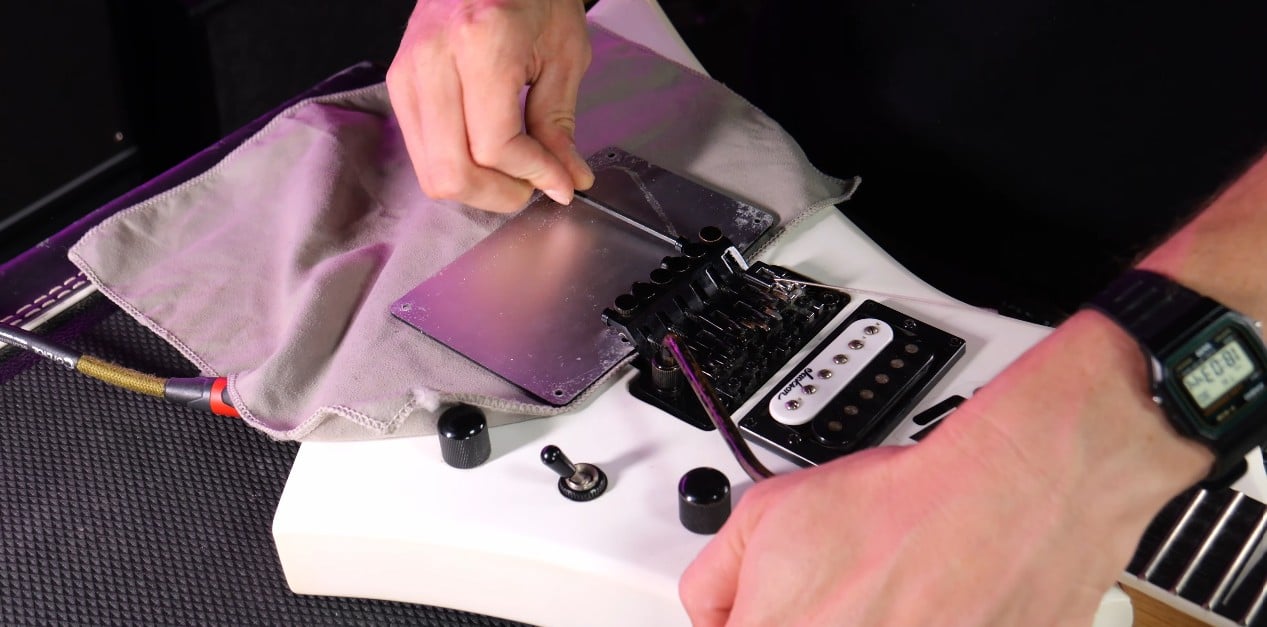
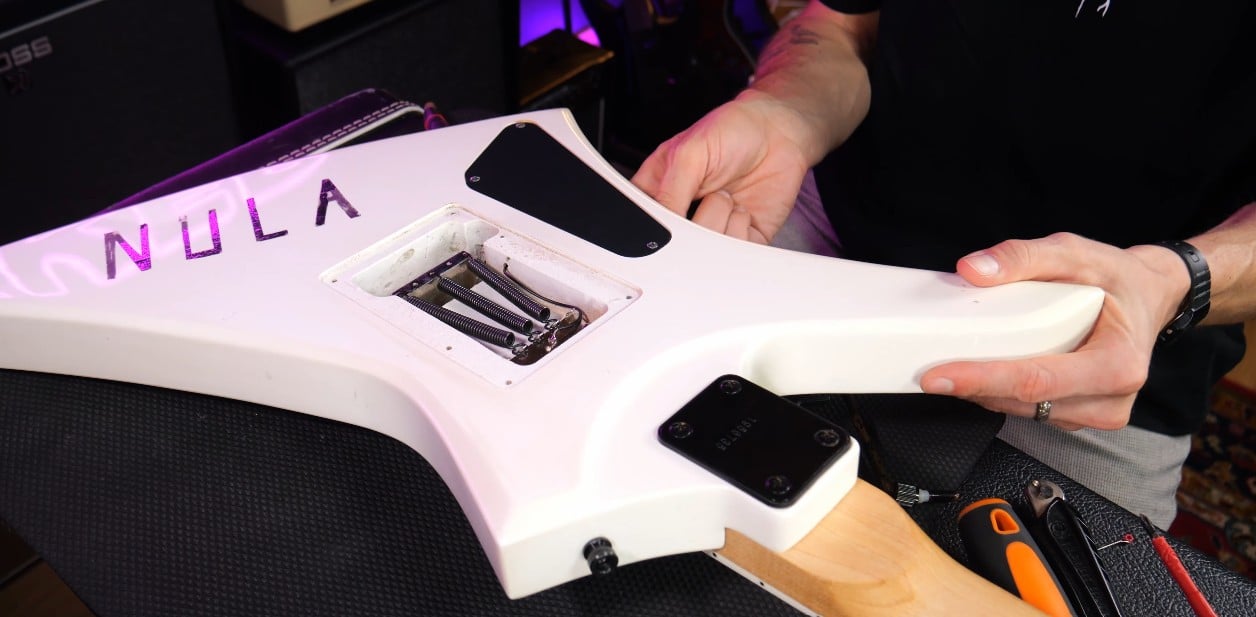
This is the trick that saves you the most time. Take off the back cover, grab a cloth and prop up the tremolo so it stays level. When you then drop the strings, the system loses tension but nothing collapses. The whole job is instantly faster and cleaner.
Loosen the saddle blocks with a 3mm Allen key and pull the strings out. Get your Allen keys and the rest of your guitar tools ready in advance, without them you will not get near a Floyd.
There are two string mounting systems. On Ibanez guitars the string runs through the body and the ball end is used, so you cut nothing. On a classic Floyd, a Squier for example, you cut the ball end off and clamp the string in the saddle block. The blocks are tiny and disappear in seconds, so keep them all in one place. If one does go missing, you will find it among the spare parts.
3. Clean and oil the fretboard
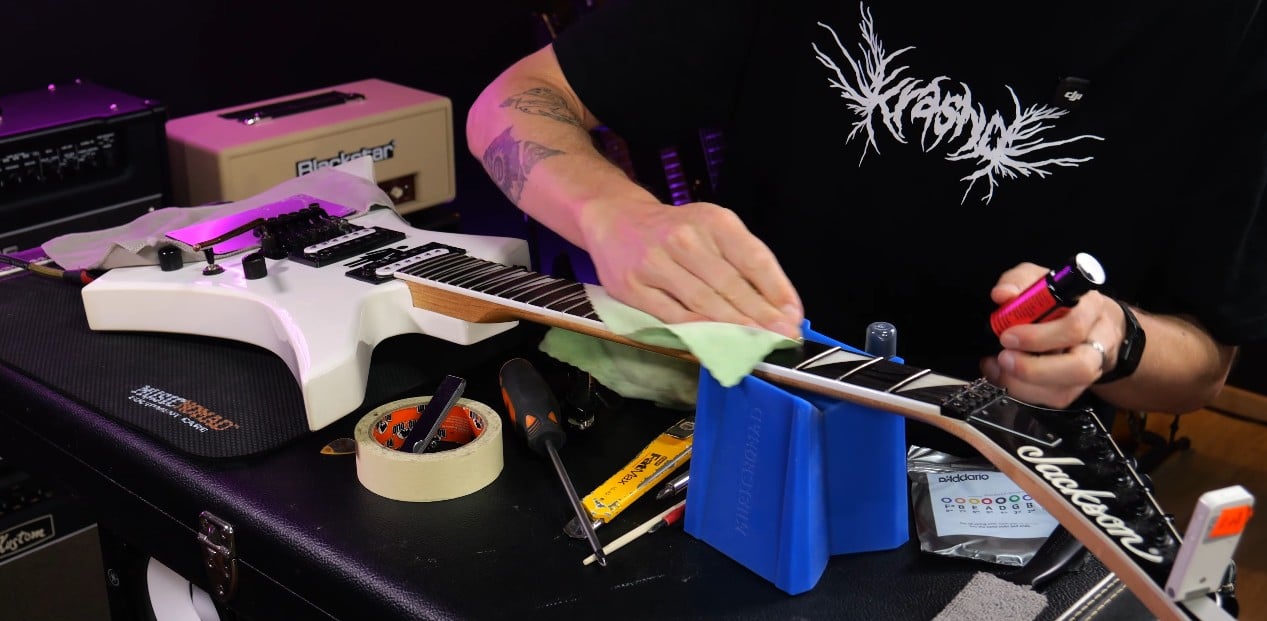
With the strings off, the fretboard is wide open. Degrease it first, then oil it. Several thin coats beat one thick one. A dry board drinks the oil, and the one in the video was exactly that dry. Check out the cleaning products you will need.
4. New strings and setting the fine tuners
Set the fine tuners before you touch the machine heads. Turn them counter-clockwise all the way, which puts them in their highest position. On a fresh setup they tend to drop as the strings settle.
The proven variation is to keep a reserve. Turn them all the way up, then come back two turns clockwise. Now you have room to adjust in both directions.
With strings the rule is simple. A heavier set lifts the bridge, a lighter one pulls it down. So if you experiment with gauges or drop tunings, expect to redo the entire balance. This guitar had tens on it, so we fitted tens again. Lukas has played D'Addario for years because he likes how they feel under the fingers. That is his preference, not a rule.

5. Tuning and locking the saddle blocks
Do not lock the saddle blocks one by one from top to bottom. Lock them in pairs so the strings you have already clamped do not affect the rest.
Start with the low E, because it has the most tension. Tune it exactly together with the A and clamp the first block right away. Those two strings are now out of the equation. Then tune the D and G, clamp them, and finish the last pair the same way. Check the tuning after every clamp, because tightening the block moves the string. In the video the A dropped after clamping while the B jumped up. Fine-tune the rest with the fine tuners and a clip-on tuner.
Tighten the blocks properly hard. More rather than less, because a loose string will slip out and cause tuning instability. The limit is obvious, you must not crush the string flat.

6. Springs: how to balance the trem parallel to the body
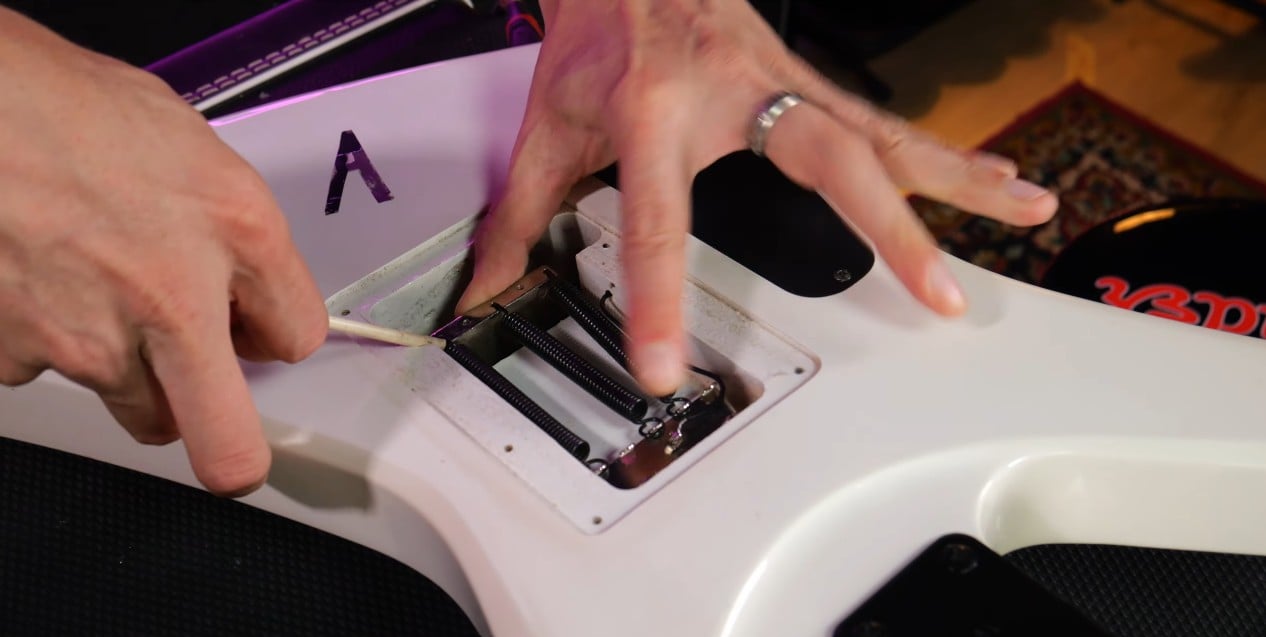
Now go round the back. What keeps the whole Floyd Rose level are the springs in the back cavity. There are three as standard and you have two ways to add tension. Either move the springs closer together on the claw, or tighten the two screws that hold the claw in the body.
The goal is clear. The bridge has to sit parallel to the body, at both ends. On this guitar the bottom edge sat nicely against the body but the top edge stuck out slightly. The fix was moving one spring to a different pin so it added tension on the bass side.
Think of it as balancing on two screws. String tension on one side, spring tension on the other, that is all there is to it. Every guitar behaves a little differently.
7. What if the claw screws are already maxed out?
This is exactly where most people get stuck. The claw screws are driven all the way into the body, tension is maxed and the bridge still is not level. The answer is to add a spring and back the screws off. Five springs fit in the cavity.
Here is the rough rule. One gauge step heavier strings means roughly one more spring. With heavier sets, go to four without hesitation. You can also buy springs with different tension, and on older guitars the original ones are often simply worn out.
Count on two things. After adding a spring you have to retune the whole guitar and start over. And the more springs, the stiffer the bar feels. If you want an expressive Steve Vai system out of your Floyd, keep it at three springs. Two springs work for nines or tens dropped a semitone.

8. Octaves and intonation on locked saddle blocks
On a Floyd the saddle blocks are locked, so you cannot slide them with a screwdriver from the back like on regular bridges. That is deliberate, and it is exactly what holds the tuning stable and returns the pitch to where it started when you give the guitar a hard time.
The process is slow but straightforward. Release the string tension, loosen the saddle screw, move the block slightly, tighten the screw, bring the string back to pitch, check and adjust. If you moved it the wrong way, repeat.
Move it in tiny increments. Big jumps force you to run the whole loop again.
9. How do you test whether a Floyd holds tuning?
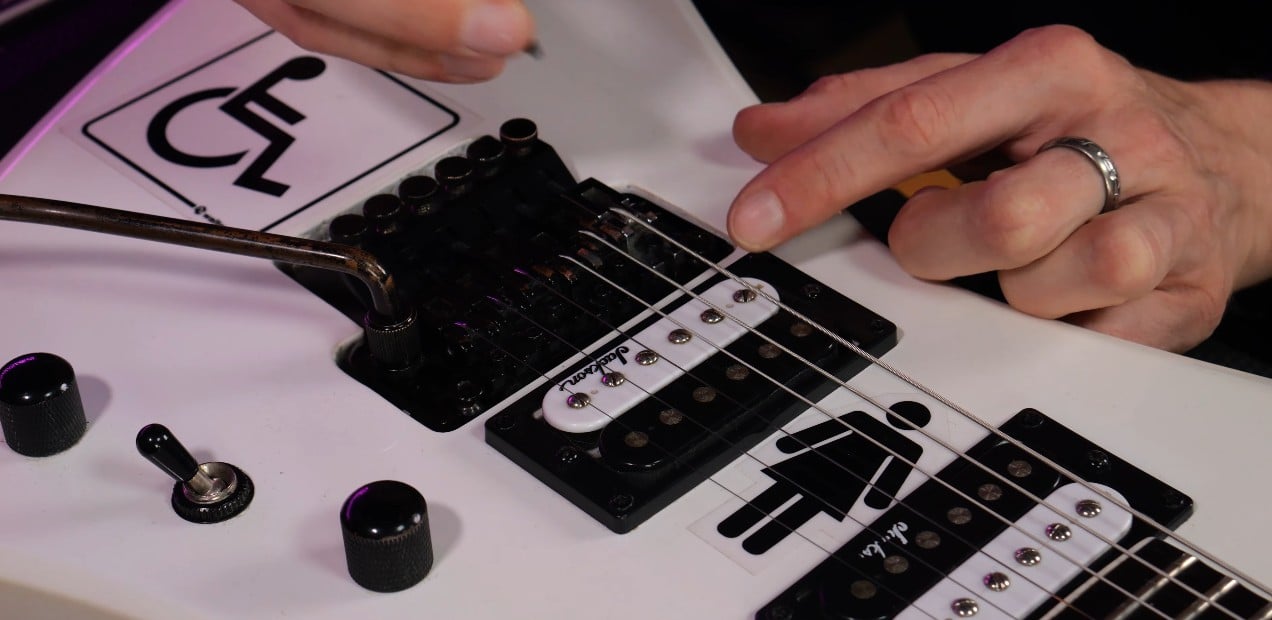
Use the bar and check whether the pitch comes back. With a well set-up system the guitar will stay in tune. It will not survive a whole gig though, you will be touching the fine tuners anyway. When you push the bar down, the G and E go slack the most, so watch those first.
The second test is palm muting. Rest your right hand on the strings near the bridge and play some chugs. The pressure of your hand moves the tremolo and the tuning drops. This is a limit of the system, not a fault in your setup.
That is why we do not recommend a Floyd Rose for recording palm-muted metal riffs, not even when it is set up perfectly. If that is exactly what you need, move on to the next step.

10. How do you block a Floyd Rose tremolo?
Blocking means filling the gap between the guitar body and the tremolo block so the system cannot move. The simplest solutions are wooden shims or coins. If you want to block the trem completely, fill both sides so it can go neither up nor down. When the trem already rests against the body, one side is enough.
This method lasts exactly until your next string change, then the shim falls out. A partial fix is changing strings one at a time so you never lose all the tension. The more permanent version is a shim cut to size and fixed into the body with a single screw.
The proper solution is a Tremol-No or another tremolo blocker, which you will find among the Floyd Rose accessories. It mounts to the claw and to the tremolo block, it is a rod with a spring and you set the exact distance with it. Once the guitar is set up, you lock it and the system moves neither forward nor backward. The bonus is that you no longer have to prop up the Floyd during string changes. There is one catch. The blocker takes the place of one spring, so factor that into the balance. And when you remove it and want the bar back, you redo the whole setup.
Floyd Rose FAQ
Why does a Floyd Rose not hold tuning?
In most cases it is the balance. The system runs on counter-tension between strings and springs, so when the bridge is not parallel to the body, the tuning will not hold. The second most common reason is new strings that are still stretching. Let the system settle, bend, use the bar and keep tuning until both the strings and the springs stabilise. Also check that the saddle blocks are clamped hard enough and that no string is slipping.
How many springs should a Floyd Rose have?
Three as standard, but five fit in the cavity. The heavier your strings, the more counter-tension you need, so with heavier sets four is perfectly fine. You can also get springs with different tension. Keep in mind that every spring you add makes the bar stiffer, so three is a good compromise between stability and feel.
How do you change strings on a Floyd Rose?
Use the back cover trick. Take off the cover, insert a cloth and prop up the tremolo so it stays level once the tension is gone. Unlock the nut, loosen the saddle blocks with a 3mm Allen key and pull the strings out. Tune the new strings with the machine heads while the nut is still unlocked, then clamp the blocks in pairs and finish with the fine tuners. If your trem is blocked with a wooden shim, change the strings one at a time so the shim does not fall out.
How do you set the fine tuners on a fresh setup?
Turn them as high as they go, that is counter-clockwise to the maximum. On a fresh setup they tend to drop as the strings settle. It pays to leave two turns of reserve downward so you have room to adjust both ways. Always set the fine tuners before you start tuning with the machine heads.
Does blocking the tremolo affect intonation?
Probably not. If you block the trem in the same position the guitar was set up in, the octaves stay where they belong. With a job like this anything can happen though, so check your intonation after blocking and adjust the saddle blocks if needed.
Get to work on your setup
A Floyd Rose is not a bad system, just an uncompromising one. Give it time to settle and balance the springs against the strings, and you get a guitar that lets you do anything and comes back to pitch. One last piece of advice from the video. If you play live and use two different tunings, you need two guitars, plus a backup in the same tuning. When a string breaks on a Floyd, not even the fastest tech in the world can change it in time.
Have a look at Floyd Rose guitars, tremolos and vibratos, strings, guitar tools and other electric guitars in our range, and get to it.